|
Getting your Trinity Audio player ready...
|
Buying a hat should be simple, yet one of the most common reasons people return hats is choosing the wrong size. Whether you’re shopping for a classic cowboy hat, a fitted baseball cap, or a stylish fedora, knowing how to measure hat size is the key to finding a comfortable and secure fit.
A hat that’s too tight can leave pressure marks, cause headaches, and become uncomfortable after just a few hours. On the other hand, a hat that’s too loose may slide around, falloff in the wind, or lose its intended shape and appearance.
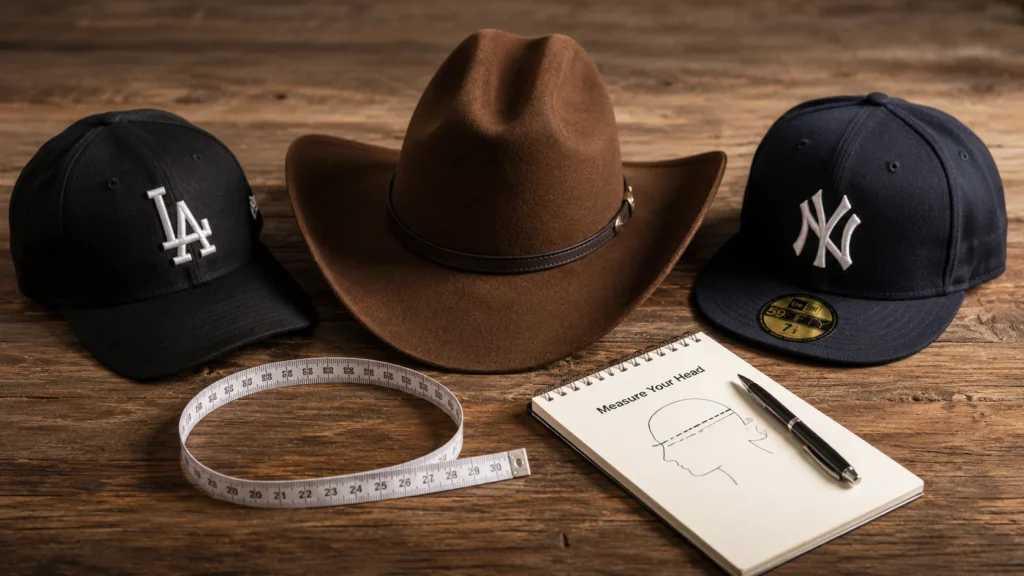
The good news? Measuring your head takes less than two minutes, and you only need a flexible measuring tape—or even a piece of string if you don’t have one.
In this complete guide, you’ll learn:
- How to measure your head for a hat correctly
- How to determine your hat size from your measurements
- The difference between measuring for cowboy hats, fitted hats, and baseball caps
- How to use a hat size chart
- Common mistakes to avoid
- Tips for getting the perfect fit every time
Whether you’re buying your first cowboy hat or adding another to your collection, this guide will help you choose the right size with confidence.
How to Measure Hat Size
If you’re looking for the fastest answer, here’s how to measure your hat size in five simple steps:
- Use a flexible measuring tape or a piece of string.
- Wrap it around the widest part of your head, about 1/8 inch (3 mm) above your eyebrows and ears.
- Keep the tape level all the way around without pulling it too tight.
- Record the measurement in inches or centimeters.
- Compare your measurement with the manufacturer’s hat size chart to find your correct size.
That’s it! While the process is simple, accuracy matters. Even a difference of half an inch (or about one centimeter) can change your hat size.
Why Measuring Hat Size Is Important
Many people assume that hats come in standard “small, medium, and large” sizes that fit everyone similarly. In reality, hat sizing varies between brands, materials, and styles.
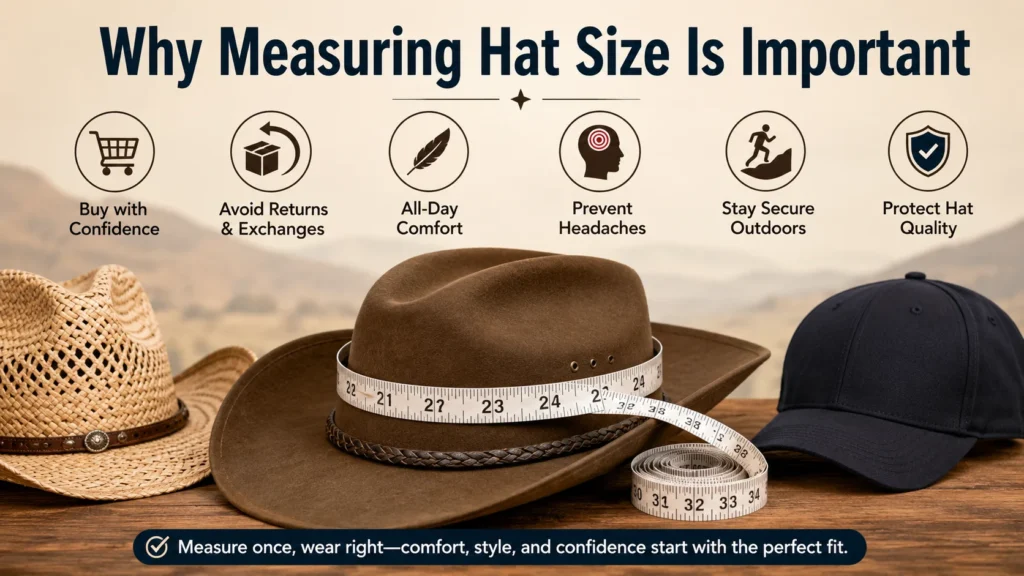
For example, a felt cowboy hat may fit differently than a straw cowboy hat, even if both are labeled as the same size. Likewise, a fitted baseball cap from one brand may feel tighter or looser than another because of differences in manufacturing.
Taking accurate measurements helps you:
- Buy hats online with greater confidence
- Avoid unnecessary returns or exchanges
- Find a hat that’s comfortable for all-day wear
- Prevent headaches caused by tight-fitting hats
- Keep your hat secure during outdoor activities
- Protect the shape and structure of premium hats
Whether you’re investing in a handcrafted cowboy hat or an everyday baseball cap, a proper fit enhances both comfort and style.
What You’ll Need
Fortunately, measuring your head doesn’t require any special equipment.
Option 1: Flexible Measuring Tape (Recommended)
A soft tailor’s measuring tape is the easiest and most accurate tool. It’s flexible enough to wrap naturally around your head and provides precise measurements in both inches and centimeters.
Option 2: String or Ribbon
If you don’t have a measuring tape, use a piece of string, ribbon, or even a shoelace.
Wrap it around your head, mark where the ends meet, then lay it flat against a ruler or tape measure to determine the length.
Optional Items
You may also find these helpful:
- A mirror to check tape placement
- A friend to assist for greater accuracy
- A notebook or phone to record your measurement
Pro Tip: Measure your head two or three times to ensure consistent results. If the measurements differ slightly, use the average or the largest measurement for the best fit.
Where Should You Measure Your Head?
One of the biggest mistakes people make is measuring the wrong part of their head.
To get an accurate hat size, the measuring tape should follow the same path that your hat’s sweatband will rest on.
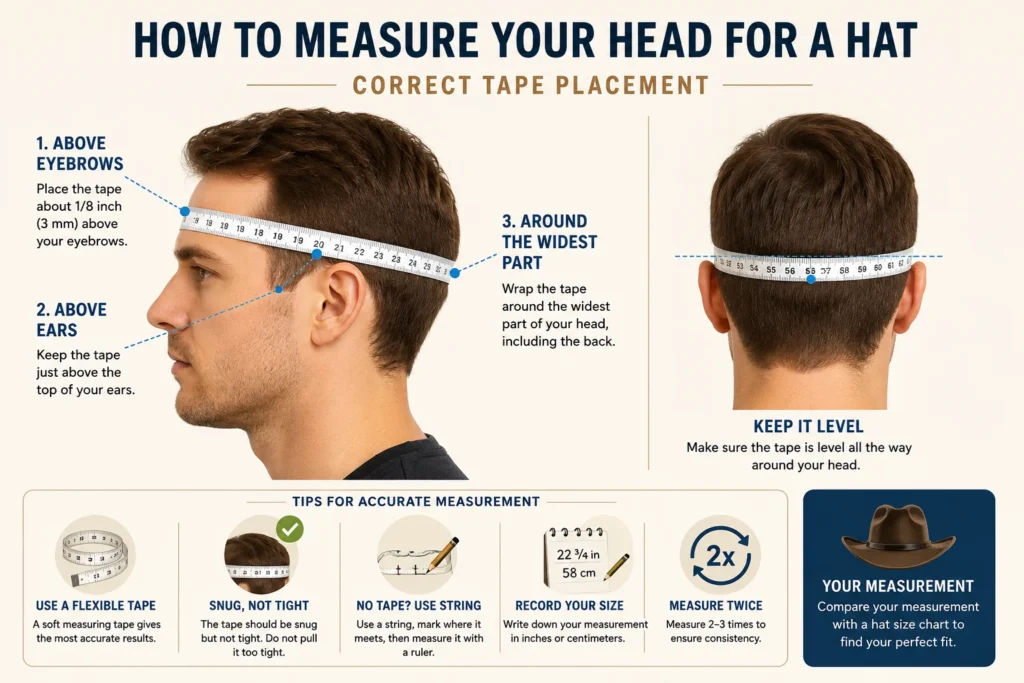
Position the Tape Correctly
Place the tape:
- Approximately 1/8 inch (3 mm) above your eyebrows
- Slightly above the tops of your ears
- Around the widest part of the back of your head
The tape should remain level all the way around.
Avoid placing it too high on your forehead or too low over your ears, as either mistake can result in an incorrect measurement.
How to Measure Your Head for a Hat (Step-by-Step)
Now that you know where to measure, let’s walk through the process in detail.
Step 1: Prepare Your Hair
Before measuring, wear your hair the way you normally would when wearing a hat.
If you usually wear your hair in a bun, ponytail, or braid under your hat, keep it that way while measuring.
If your hairstyle changes frequently, measure with your most common hairstyle to ensure the best everyday fit.
People with thick or curly hair may want to take two measurements—one with flattened hair and one with natural volume—to determine which size feels most comfortable.
Step 2: Wrap the Measuring Tape Around Your Head
Take your flexible measuring tape and wrap it around your head.
The tape should sit:
- Just above your eyebrows
- Slightly above your ears
- Across the widest point of the back of your head
Keep the tape snug but not tight.
Imagine how a comfortable hat should feel. The measuring tape should mimic that fit.
If you’re using string instead, hold it firmly in place before measuring it with a ruler.
Step 3: Keep the Tape Level
This step is often overlooked.
The tape should remain perfectly horizontal around your head.
If one side slips higher or lower than the other, your measurement may be inaccurate.
Using a mirror can help you verify that the tape stays level throughout the process.
Step 4: Record Your Measurement
Once you’re satisfied with the tape placement, note the measurement.
Most hat manufacturers provide sizing in either:
- Inches
- Centimeters
- US hat sizes
- International sizes (S, M, L, XL)
If your measurement falls between two sizes, don’t worry—we’ll explain how to choose the right size later in this guide.
Step 5: Measure Again
Professional hat retailers often recommend measuring at least twice.
A second measurement helps eliminate small errors caused by tape placement or tension.
If your second measurement matches the first, you can confidently use that number when shopping for hats.
Common Mistakes When Measuring Hat Size
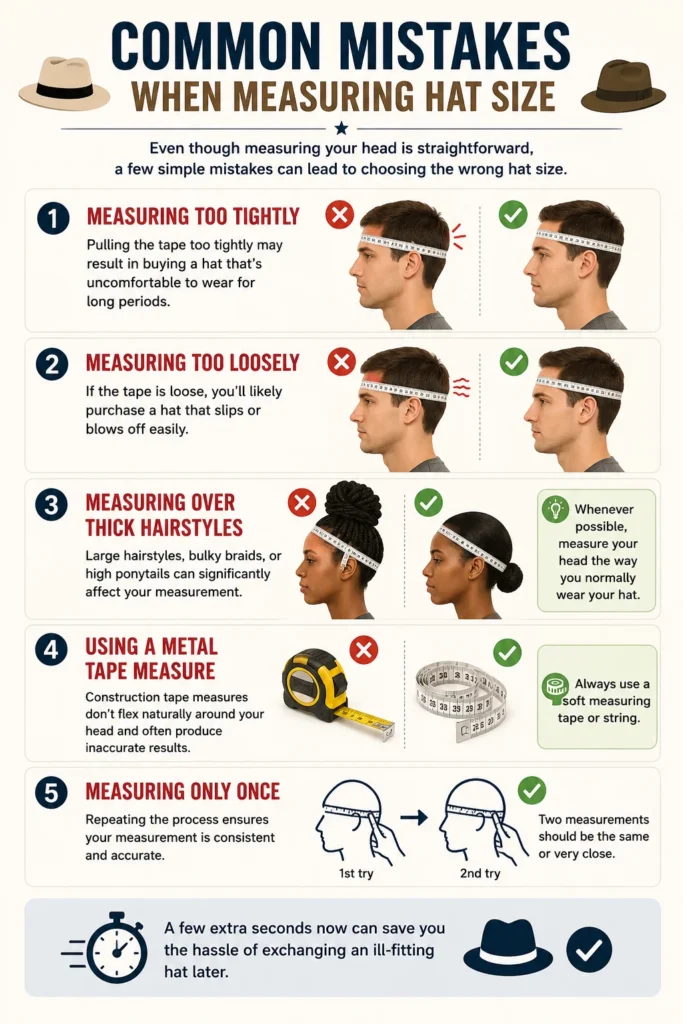
Even though measuring your head is straightforward, a few simple mistakes can lead to choosing the wrong hat size.
Measuring Too Tightly
Pulling the tape too tightly may result in buying a hat that’s uncomfortable to wear for long periods.
Measuring Too Loosely
If the tape is loose, you’ll likely purchase a hat that slips or blows off easily.
Measuring Over Thick Hairstyles
Large hairstyles, bulky braids, or high ponytails can significantly affect your measurement.
Whenever possible, measure your head the way you normally wear your hat.
Using a Metal Tape Measure
Construction tape measures don’t flex naturally around your head and often produce inaccurate results.
Always use a soft measuring tape or string.
Measuring Only Once
Repeating the process ensures your measurement is consistent and accurate.
A few extra seconds now can save you the hassle of exchanging an ill-fitting hat later.
How to Measure Cowboy Hat Size
Cowboy hats are designed differently from baseball caps or casual hats. Because of their structured crowns and firm sweatbands, getting the correct size is especially important.
Whether you’re buying a classic felt cowboy hat or a lightweight straw hat, the measuring process starts the same way—by measuring your head circumference.
Step 1: Measure Your Head
Use the method explained earlier:
- Measure about 1/8 inch above your eyebrows.
- Keep the tape level above your ears.
- Wrap it around the widest part of your head.
- Record the measurement in inches or centimeters.
Step 2: Check the Brand’s Size Chart
Different Western brands may fit slightly differently.
Some manufacturers produce hats with a more oval shape, while others have a rounder fit. Two hats labeled as size 7 1/4 can feel noticeably different depending on the brand and construction.
Always compare your measurement with the manufacturer’s official size guide.
Step 3: Consider the Hat Material
Material affects fit more than many first-time buyers realize.
Felt Cowboy Hats
Felt hats usually feel snug at first but often conform slightly to the shape of your head after regular wear.
Straw Cowboy Hats
Straw hats generally stretch much less than felt hats. Because of this, choosing the correct size from the beginning is especially important.
Leather Cowboy Hats
Leather may soften and loosen slightly over time, but significant stretching should not be expected.
How Should a Cowboy Hat Fit?
A properly fitted cowboy hat should:
- Sit comfortably around your forehead.
- Rest evenly without tilting.
- Stay in place when you bend forward.
- Not leave deep pressure marks after short wear.
- Feel secure without squeezing your head.
If the hat leaves a headache after 15–20 minutes, it’s probably too small.
If it rocks from side to side or falls off easily, it’s likely too large.
Expert Tip: Many premium Western hat owners prefer a slightly snug fit because the sweatband naturally conforms to the wearer’s head over time.
Common Cowboy Hat Sizing Mistakes
Avoid these common mistakes:
- Buying based only on “Small,” “Medium,” or “Large.”
- Assuming every Western brand fits the same.
- Ignoring differences between felt and straw hats.
- Measuring over thick hairstyles that you don’t normally wear under a hat.
- Guessing your size instead of measuring.
How to Measure a Fitted Hat
Unlike adjustable caps, fitted hats rely entirely on accurate sizing.
Brands such as New Era, 47 Brand, and other fitted cap manufacturers use numerical sizing based on head circumference.
Fortunately, measuring for a fitted hat is almost identical to measuring for a cowboy hat.
Step 1: Measure Your Head
Wrap a flexible measuring tape:
- Above your eyebrows
- Just above your ears
- Around the widest part of your head
Keep the tape snug but comfortable.
Step 2: Compare With a Fitted Hat Size Chart
Most fitted hats use standard US hat sizes such as:
- 6 7/8
- 7
- 7 1/8
- 7 1/4
- 7 3/8
- 7 1/2
- 7 5/8
Always verify the brand’s sizing guide before purchasing.
Should Fitted Hats Feel Tight?
A fitted hat should feel secure without creating uncomfortable pressure.
When new, the sweatband may feel slightly firm, but it shouldn’t:
- Cause headaches
- Leave deep indentations
- Require force to put on
Over time, many fitted caps mold slightly to your head, creating a more customized fit.
How to Measure Baseball Hat Size
Baseball caps come in several styles, including:
- Adjustable caps
- Snapbacks
- Strapback hats
- Flexfit caps
- Fitted baseball caps
Adjustable Hats
Since these hats include an adjustable strap or buckle, measuring isn’t always necessary.
However, knowing your head circumference still helps you determine whether a cap will fit within its adjustment range.
Snapbacks
Snapbacks typically fit a wide range of head sizes, but people with very small or very large heads may still benefit from measuring before purchasing.
Flexfit Hats
Stretch-fit caps combine elastic materials with fixed sizing.
Although more forgiving than fitted hats, choosing the correct size remains important for comfort.
Fitted Baseball Caps
These require the most accurate measurements because they offer no adjustment mechanism.
Men’s Hat Size Guide
Men’s hats generally follow standard US sizing.
Common sizes include:
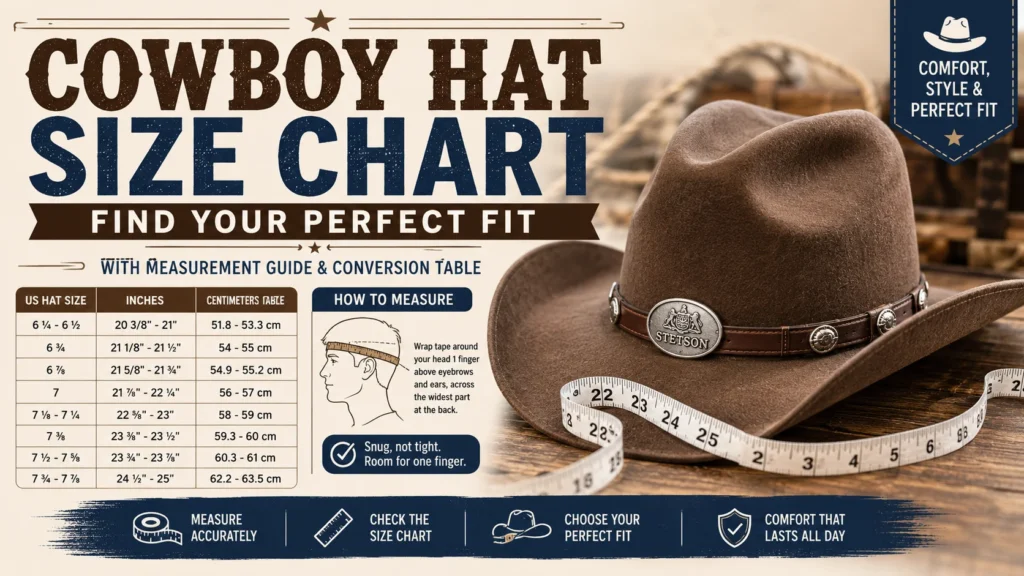
| US Size | Head Circumference |
| 6 7/8 | 21 5/8 in (55 cm) |
| 7 | 22 in (56 cm) |
| 7 1/8 | 22 3/8 in (57 cm) |
| 7 1/4 | 22 3/4 in (58 cm) |
| 7 3/8 | 23 1/8 in (59 cm) |
| 7 1/2 | 23 1/2 in (60 cm) |
Remember that sizing can vary slightly between manufacturers, so always compare your measurement with the brand’s chart.
Women’s Hat Size Guide
Many fashion hats today are designed as unisex, meaning men’s and women’s sizing often follows the same measurement standards.
The primary difference lies in style rather than size.
Women’s hats may feature:
- Smaller brims
- Different crown shapes
- Decorative trims
- Fashion-focused silhouettes
Regardless of style, measuring your head follows exactly the same process described earlier.
What If You’re Between Two Hat Sizes?
This is one of the most common questions shoppers ask.
If your head measurement falls exactly between two sizes, consider the following factors.
Choose the Larger Size If:
- You’re buying a straw hat.
- You have thick hair.
- You plan to wear the hat for long periods.
- The brand is known for a tighter fit.
Choose the Smaller Size If:
- The manufacturer recommends sizing down.
- You’re buying a felt hat that may conform slightly over time.
- You prefer a snug fit for active outdoor use.
If you’re unsure, ordering the larger size and using hat sizing tape is often the safer option.
Do Hat Sizes Vary Between Brands?
Yes.
Even when two hats carry the same size label, they may fit differently because of differences in:
- Sweatband construction
- Crown shape
- Manufacturing tolerances
- Materials
- Country of manufacture
This is why measuring your head is only the first step. Always compare your measurement with the specific size chart provided by the manufacturer before placing an order.
Pro Tips for Buying Hats Online
Buying a hat online offers access to hundreds of styles and brands, but it also comes with one challenge—you can’t try it on before making a purchase. Fortunately, a few simple practices can help you order the right size and avoid unnecessary returns.
Measure Your Head Every Time
Don’t rely on memory or the size of a hat you bought years ago. Weight changes, hairstyles, and even different brands can affect how a hat fits. Measuring your head before each purchase ensures you’re choosing the correct size.
Check the Brand’s Size Chart
While US hat sizes are generally standardized, manufacturers may have slight differences in sizing. Always compare your head measurement with the specific size chart provided by the brand.
Read Customer Reviews
Reviews often reveal useful details about fit. Look for comments such as:
- “Runs small”
- “Fits true to size”
- “Better to size up”
- “Stretches after wearing”
These insights can help you decide if you should order your usual size or make an adjustment.
Consider the Hat Material
Different materials fit differently.
- Felt hats may soften and conform slightly with wear.
- Straw hats typically maintain their original size and stretch very little.
- Leather hats may become more flexible over time but should still fit comfortably from the start.
- Wool hats can shrink if exposed to excessive moisture or heat.
Understand the Return Policy
Before placing your order, check whether the retailer allows exchanges or returns. This is especially important when purchasing premium cowboy hats or limited-edition fitted caps.
Frequently Asked Questions
How do I measure my head for a hat?
To measure your head for a hat, use a flexible measuring tape and wrap it around the widest part of your head. Position the tape about 1/8 inch (0.3 cm) above your ears and across the middle of your forehead, keeping it level all the way around. The measurement you get in inches or centimeters is your head circumference, which you’ll use to determine your hat size.
What tools do I need to measure my hat size?
The easiest tool is a soft measuring tape used for sewing. If you don’t have one, you can use a piece of string or ribbon, wrap it around your head, and then measure its length with a standard ruler or tape measure. Make sure the measuring tool is snug but not tight for the most accurate result.
Where should I measure around my head?
Measure around the widest part of your head, which is typically:
- About 1/8 inch (0.3 cm) above your ears
- Across the center of your forehead
- Around the back of your head at its fullest point
Keeping the measuring tape level ensures you get an accurate head circumference.
How do I convert inches or centimeters into a hat size?
After measuring your head circumference, compare the measurement with a hat size chart. Most charts list corresponding sizes in inches, centimeters, and standard hat sizes. For example, a head circumference of 22 inches (56 cm) typically corresponds to a US hat size 7 or a Medium (M), though sizing may vary slightly by manufacturer.
What is a hat size chart?
A hat size chart is a reference table that converts your head circumference into the appropriate hat size. It usually includes:
- Head measurements in inches and centimeters
- Numeric hat sizes (such as 6 7/8, 7, or 7 1/4)
- Letter sizes like S, M, L, XL, and XXL
- International size conversions for different regions
Using a size chart helps you choose a hat that fits comfortably and securely.
How do hat sizing systems differ (US, UK, EU, and S/M/L/XL)?
Hat sizing systems vary depending on the country and brand:
- US sizes use fractional numbers, such as 7, 7 1/8, or 7 1/4.
- UK sizes are similar to US sizing but may differ slightly in conversion.
- EU sizes are based directly on head circumference in centimeters, such as 56, 58, or 60.
- Letter sizes (S, M, L, XL) group a range of measurements together for easier shopping.
Always check the brand’s sizing chart before purchasing, as size ranges can differ slightly between manufacturers.
How tight should a hat fit?
A properly fitted hat should feel secure without causing discomfort.
It should:
- Stay in place while you move.
- Leave little or no pressure marks.
- Feel snug but not restrictive.
- Avoid sliding over your eyes.
If a hat causes headaches or feels overly tight after a few minutes, it’s likely too small.
What if I’m between two hat sizes?
If you’re between sizes, choosing the larger size is often the safer option. You can improve the fit using hat sizing tape or foam inserts.
This approach is especially helpful for straw hats and hats that don’t stretch.
Do cowboy hats stretch over time?
Felt cowboy hats may conform slightly to the shape of your head with regular wear.
Straw cowboy hats generally stretch very little, so choosing the correct size from the beginning is important.
Are men’s and women’s hat sizes different?
The measuring process is exactly the same for everyone.
Many hat brands use unisex sizing based solely on head circumference. The primary differences between men’s and women’s hats usually involve style, crown shape, brim width, and decorative features rather than measurement.
Can I use a ruler instead of a measuring tape?
Yes.
Simply wrap a piece of string or ribbon around your head, mark where the ends meet, then measure the string with a ruler or standard tape measure.
How often should I measure my head?
It’s a good idea to measure your head before purchasing a new hat, especially if:
- It’s been several years since your last measurement.
- You’ve changed hairstyles.
- You’re trying a new hat brand.
- You’re purchasing a premium fitted hat or cowboy hat.
Common Hat Sizing Myths
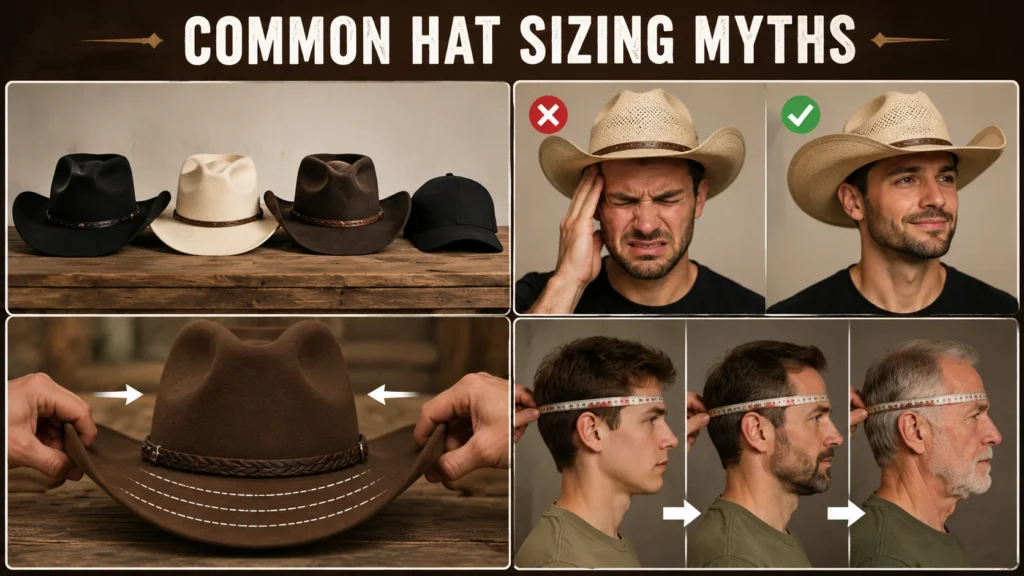
Many people believe hat sizing is more complicated than it really is. Let’s clear up a few common misconceptions.
Myth 1: All Size Large Hats Fit the Same
Not necessarily.
Different manufacturers use different sizing standards, sweatbands, and crown shapes. A Large from one brand may fit differently from another.
Myth 2: Cowboy Hats Should Always Feel Tight
A cowboy hat should feel secure, but it shouldn’t cause discomfort. A properly fitted hat stays in place without squeezing your head.
Myth 3: Hats Stretch a Full Size
Most hats stretch only slightly, if at all. Never buy a hat that’s noticeably too small expecting it to stretch into the perfect fit.
Myth 4: You Only Need to Measure Once
Head measurements can change over time due to hairstyles, age, and other factors. Measuring again before buying a new hat helps ensure the best fit.
Final Thoughts
Finding the right hat size isn’t difficult, It simply starts with an accurate measurement.
Whether you’re shopping for a classic cowboy hat, a fitted baseball cap, a straw Western hat, or your everyday favorite, taking a few minutes to measure your head can save you from uncomfortable fits, costly returns, and unnecessary frustration.
To recap:
- Measure around the widest part of your head.
- Keep the measuring tape level above your eyebrows and ears.
- Record the measurement in inches or centimeters.
- Compare it with the manufacturer’s size chart.
- If you’re between sizes, consider sizing up and using hat sizing tape if needed.
Remember that every brand fits a little differently, so don’t rely solely on the size printed inside your current hat. Always verify your measurements before making a purchase.
A well-fitting hat doesn’t just feel better, it looks better, lasts longer, and gives you the confidence to wear it wherever your adventures take you.
Related Guides on HatWanderer.com
Continue exploring our expert resources:
The Complete Cowboy Hat Guide: Styles, Shapes, Sizes & Perfect Fit
Cowboy Hat Size Guide: How to Tell If Your Cowboy Hat Fits (Too Small or Too Big)
The Ultimate Western Hat Size Chart: Inches, Centimeters, and Fractional Sizes Explained
Cowboy Hat Size Chart: Find Your Perfect Fit (With Measurement Guide)

Mike Wilson is a Western fashion enthusiast, content creator, and founder of HatWanderer.com. He shares expert insights, buying guides, and honest reviews to help readers choose the right cowboy hats and Western apparel.
Passionate about Western culture and craftsmanship, Mike covers hat styles, fit, materials, care, and the heritage behind iconic Western brands. His goal is to help both newcomers and longtime enthusiasts build a timeless Western wardrobe with confidence.
When he’s not writing, Mike enjoys exploring Western fashion trends, studying the history of cowboy culture, and discovering quality craftsmanship from respected hat makers.